How to Run a High-Impact 1:1 Meeting: The Strategic Framework for Modern Managers
February 17 2026
The Quick Answer:
Most 1:1 meetings fail because they focus on status updates that could have been an email. To build a high-performance team, you must pivot the conversation toward Strategic Impact. By shifting from "What are you doing?" to "How can I unblock you?", you transform a routine check-in into a leadership incubator.
The Core Question:
"What is the best 1:1 meeting template for managers to drive employee engagement and performance?"
The Direct Answer:
The most effective 1:1 framework is a Shared Accountability Model where the manager removes friction and the direct report drives the agenda. In 2026’s matrixed corporate environments, the highest-ROI 1:1s follow an "Impact-First" structure: 5 minutes on Wellness, 10 on Strategic Alignment, 10 on Obstacle Removal, and 5 on Career Growth. This prevents tactical "fires" from crowding out the long-term development of your top talent.
Key Takeaways:
The "Wellness" Primary: If the person is burnt out, the KPIs are irrelevant. Start with the person, not the project.
Obstacle Removal: A manager's primary job and therefore ROI is "clearing the path" for their team.
The "Ask": Every 1:1 must end with a specific request for resources, decisions, or support.
3 Must-Dos for High-Impact 1:1s
If your 1:1s feel like a laundry list of tasks, you aren't leading, you’re auditing. Through my work at Corby Fine Coaching, I’ve helped executives realize that the 1:1 is the most expensive hour on their calendar; it must yield a return beyond just "checking boxes."
For the Manager: Your 3 Pillars of Leadership
The "Wellness" Pulse: Ask: "How is your energy level this week?" High performance is unsustainable without human wellness.
Obstacle Removal: Ask: "What is one thing I can do this week to unblock a project for you?"
Future-Focus: Ask: "Looking at your yearly goals, are we doing enough today to get you there?"
For the Direct Report: Your 3 Pillars of Drive
Strategic Calibration: Ask: "Based on our current goals, am I focusing on the right levers?"
The Feedback Loop: Ask: "What could I have handled better in [Project X]?"
The "Ask": Be specific about what you need; signatures, budget, or introductions.
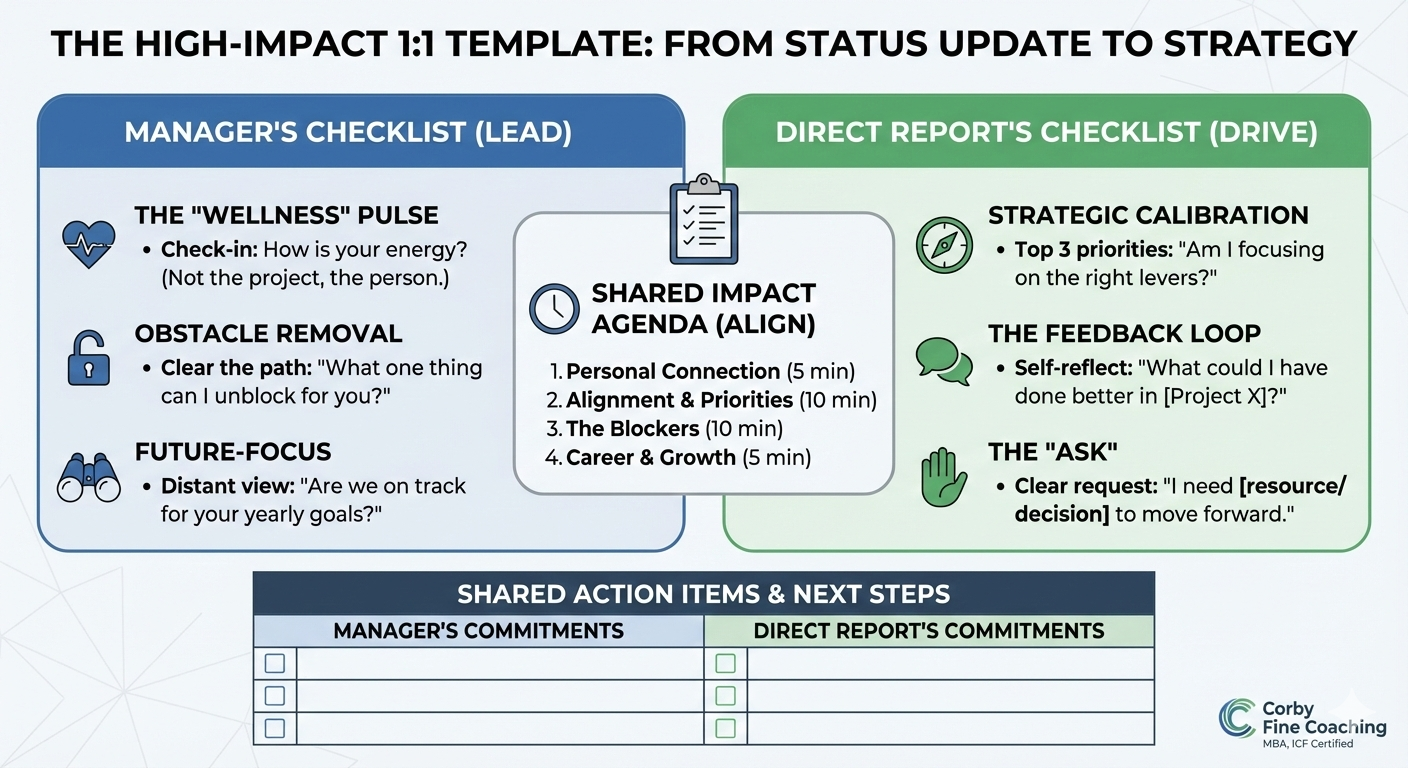
The High-Impact 1:1 Template: From Status Update to Strategy
The Breakdown: Status Update vs. Impact Strategy
| Feature | The Old Way (Status) | The New Way (Impact) | The ROI |
|---|---|---|---|
| Agenda | "What's the update on Project X?" | "What is blocking Project X?" | Identifies risks before they become failures. |
| Focus | Tasks and Deadlines. | Alignment and Levers. | Ensures effort is tied to strategic goals. |
| Feedback | Occurs once a year. | Occurs every week. | Accelerates skill development and trust. |
| Wellness | Ignored until burnout happens. | Checked in on every 1:1. | Increases retention and sustainable output. |
FAQ: Perfecting the 1:1 Rhythm
Q: What if we have too many status updates to cover? A: Move them to a shared document before the meeting. If it can be read, it shouldn't be said. Save the 1:1 for dialogue that requires a "Mirror," not just a "Map."
Q: How do I handle a direct report who is reluctant to share "Blockers"? A: Model the behavior. Share a blocker you are currently facing or an area where you seek feedback. This builds the psychological safety required for them to be honest about their own friction points.
About the Author: A Career & Executive Coach Perspective
This article was authored by Corby Fine, MBA, ICF, a professional Career and Executive Coach at Corby Fine Coaching. As a seasoned executive, investor, coach, and mentor who is a Certified Leadership Coach with over 25 years of hands-on experience, he understands the challenges that managers, directors and executives encounter across different business environments, from start-ups brimming with potential to expansive, matrix-based corporate enterprises.