Master Continuous Improvement Methodologies for Career Growth
February 23 2026
When you hear "continuous improvement methodologies," what comes to mind? For most people, it’s manufacturing floors, complicated charts, and a whole lot of corporate jargon. It sounds like something reserved for big companies trying to shave a few seconds off an assembly line.
But what if I told you these frameworks are actually a secret weapon for your own career?
From Corporate Jargon to Career Superpower

Let's strip away the buzzwords. At its core, continuous improvement isn't about factories; it's a mindset. It's about making small, deliberate, and consistent refinements over time. Think of it less like a corporate mandate and more like a musician mastering their craft.
A concert pianist doesn't just show up and become a virtuoso overnight. Mastery comes from daily practice. They isolate tricky passages, refine their technique, and make tiny adjustments. Each session makes them a fraction better, and over years, those tiny gains compound into breathtaking skill.
That's continuous improvement in a nutshell.
Your Career Isn’t a Ladder, It’s a Project
When you start seeing your career through this lens, everything changes. It's no longer a random series of jobs you fall into or promotions you hope for. It becomes a project—a project you actively manage, measure, and improve. The core idea is shifting from being a passive passenger to the active driver of your own professional life.
This mindset changes how you operate:
You proactively build skills. Instead of waiting for a training course your boss assigns, you spot a skill gap and create a small, daily habit to close it.
You systematically solve problems. When you hit a roadblock, you don't just get frustrated. You dig in, find the root cause, and make sure it doesn't happen again.
You actively increase your value. By consistently tweaking and refining your work, you produce higher-quality results, making yourself indispensable.
The goal is to stop simply doing your job and start consciously engineering your professional growth. It means treating your daily tasks, your skills, and your entire career path as systems that can be analyzed, optimized, and improved.
Ditching the Buzzwords for Real Results
"Continuous improvement" might feel abstract, but its application is incredibly concrete. It boils down to asking practical questions, every single day. Where did I waste time today? What tiny thing could I do more efficiently tomorrow? What one piece of feedback can I apply to my next project?
When you adopt this approach, you stop waiting for an annual review to tell you how you're doing. You create your own feedback loop, making adjustments in real-time. This proactive stance gives you more control, helps you navigate workplace challenges, and allows you to build a career that is intentional and uniquely yours.
This guide will demystify the core continuous improvement methodologies, translating them from corporate-speak into practical tools for your personal career. We’ll look at how these powerful frameworks can help you eliminate frustrating work, build valuable skills, and produce work that gets you noticed—setting the stage for real, tangible growth.
Drowning in buzzwords? You’re not alone. The world of process improvement is full of jargon that can feel totally disconnected from your day-to-day job. But hidden underneath those corporate-speak terms are three powerful ideas that can genuinely change your career path.
Let's cut through the noise and demystify the big three: Kaizen, Lean, and Six Sigma. Think of them not as boring corporate mandates, but as practical tools you can start using right now to get ahead.
Kaizen: The 1% Better Rule
Kaizen is a Japanese term that roughly means "change for the better." In practice, it’s all about making tiny, incremental improvements over and over again. Instead of trying to pull off a massive, disruptive overhaul, you focus on small, daily tweaks that compound into huge wins over time.
Think of it as the 1% better rule for your career. A graphic designer doesn’t become a master by redesigning their entire portfolio overnight. They get there by learning one new keyboard shortcut today, trying out a new font pairing tomorrow, and spending ten minutes each morning studying a design they admire. Each action is small, almost unnoticeable on its own.
But over a year, those tiny efforts add up. That one shortcut saves seconds on every project, eventually turning into hours. Those daily font experiments build an intuitive feel for typography. The morning study sessions cultivate a sophisticated design eye. This is Kaizen in action—the relentless pursuit of small, positive changes.
The real point of Kaizen isn't just to improve metrics; it's to develop people. By engaging in small, continuous improvements, you're not just making your work better—you're making yourself better.
So what does this look like in the real world?
Skill Refinement: Spending 15 minutes a day practising a specific coding function or a new feature in a software program you use.
Process Tweaking: At the end of each week, asking yourself, "What's one small thing I can do to make my weekly report a little smoother next week?"
Knowledge Building: Reading one industry article during your morning coffee instead of mindlessly scrolling through social media.
The power of Kaizen is that anyone can do it. It doesn’t require a big budget or a green light from your boss. It just requires a commitment to being slightly better today than you were yesterday.
Lean: Your Professional Decluttering Tool
If Kaizen is about adding small improvements, Lean is about ruthlessly cutting out whatever doesn't add value. Lean thinking started in manufacturing with a laser focus on eliminating "waste"—any activity that eats up resources but doesn't actually contribute to the final product.
For your career, think of Lean as a professional decluttering method. It’s the tool you use to identify and kill the time-wasting tasks, pointless meetings, and redundant processes that drain your energy and keep you from doing high-impact work.
Imagine your workday is a kitchen, and you need to cook a gourmet meal (your most important project). A Lean approach is like looking at your messy countertop and asking what’s getting in the way. Is it the pile of junk mail (useless emails)? The broken toaster (a buggy software tool)? The disorganized spice rack (a chaotic file system)? Lean helps you clear the counter so you can actually cook.
This is especially powerful in big, bureaucratic organizations where processes get bloated over time. While getting hard data on how many companies in a specific region use these methods can be tough, the principles are universal. For example, when you look at efforts to improve large systems like California's community schools, you often see a focus on structural change, which aligns perfectly with Lean's goal of trimming the fat.
Six Sigma: Your Personal Quality Control System
While Lean focuses on speed and efficiency by removing waste, Six Sigma is all about quality and consistency by eliminating defects. It’s a data-heavy methodology for finding and removing the root causes of errors in a process, with the goal of getting as close to perfection as possible.
In your career, Six Sigma is your personal quality control system. It's the framework you pull out for high-stakes projects where mistakes are expensive. Think of it as the mindset of an airline pilot running through a pre-flight checklist. The goal isn’t just to fly the plane efficiently (Lean) or to have improved the takeoff a tiny bit over time (Kaizen); it’s to ensure this specific flight is as close to error-free as humanly possible.
A Six Sigma mindset means you're not just fixing mistakes as they pop up. You’re digging in to figure out why they happened and building a system to stop them from ever happening again. For example, if you keep making calculation errors in your monthly budget reports, a Six Sigma approach would be:
Measure the Problem: Track exactly how many errors you're making and where they show up.
Analyze the Cause: Realize the errors happen when you're manually copying data from one spreadsheet to another late on a Friday afternoon.
Improve the Process: Create a simple macro or template that automates the data transfer.
Control the Future State: Use the new template from now on and add a final double-check step to your process.
This shifts you from being someone who’s good at fixing problems to someone who is valued for preventing them. It proves you’re committed to excellence and reliability—two things that are absolutely critical for building trust and earning more responsibility. Each of these continuous improvement methodologies gives you a different lens to see and upgrade your work.
Choosing Your Continuous Improvement Approach
So, which of these methodologies should you focus on? It's not about picking one and ignoring the others. It's about knowing which tool to pull out of your toolbox for a specific problem. Think of them as different lenses for viewing your career challenges.
This table gives you a quick way to decide which approach fits your current situation best.
| Methodology | Best For | Core Ideas | Example Application |
|---|---|---|---|
| Kaien | Building habits and mastering skills over the long term. | Small, consistent, incremental improvements. | Committing 15 minutes every morning to practice a new software feature or learn a new sales technique. |
| Leam | Increasing your personal bandwidth and focusing on high-impact work. | Eliminating waste and non-value-added tasks. | Auditing your calendar to decline meetings without a clear agenda or automating a repetitive reporting task. |
| Six Sigma | Delivering high-stakes projects where quality and accuracy are critical. | Reducing errors and defects through data. | Creating a checklist for a complex project launch or analyzing why a marketing campaign failed to meet its goal. |
Ultimately, the smartest professionals don't just stick to one framework. They learn to blend them. You might use Lean principles to free up two hours a week, then use that newfound time for Kaizen-style skill development, and then apply a Six Sigma mindset to your next big project. That's how you build a truly resilient and high-performing career.
Putting Continuous Improvement Into Practice
Knowing the theory behind continuous improvement methodologies is one thing. Seeing them deliver real-world career wins is something else entirely. These frameworks aren’t just abstract concepts from a textbook; they're the practical tools professionals use every day to solve nagging problems, boost their value, and get noticed.
The real trick is moving from simply understanding the ideas to actually applying them when it counts.
Let's break down how people at different career stages can put these methods to work. Think of these as mini case studies showing a common workplace problem, the methodology chosen to fix it, and the tangible results.
This diagram cuts through the noise and shows the core purpose of each framework for your professional growth.
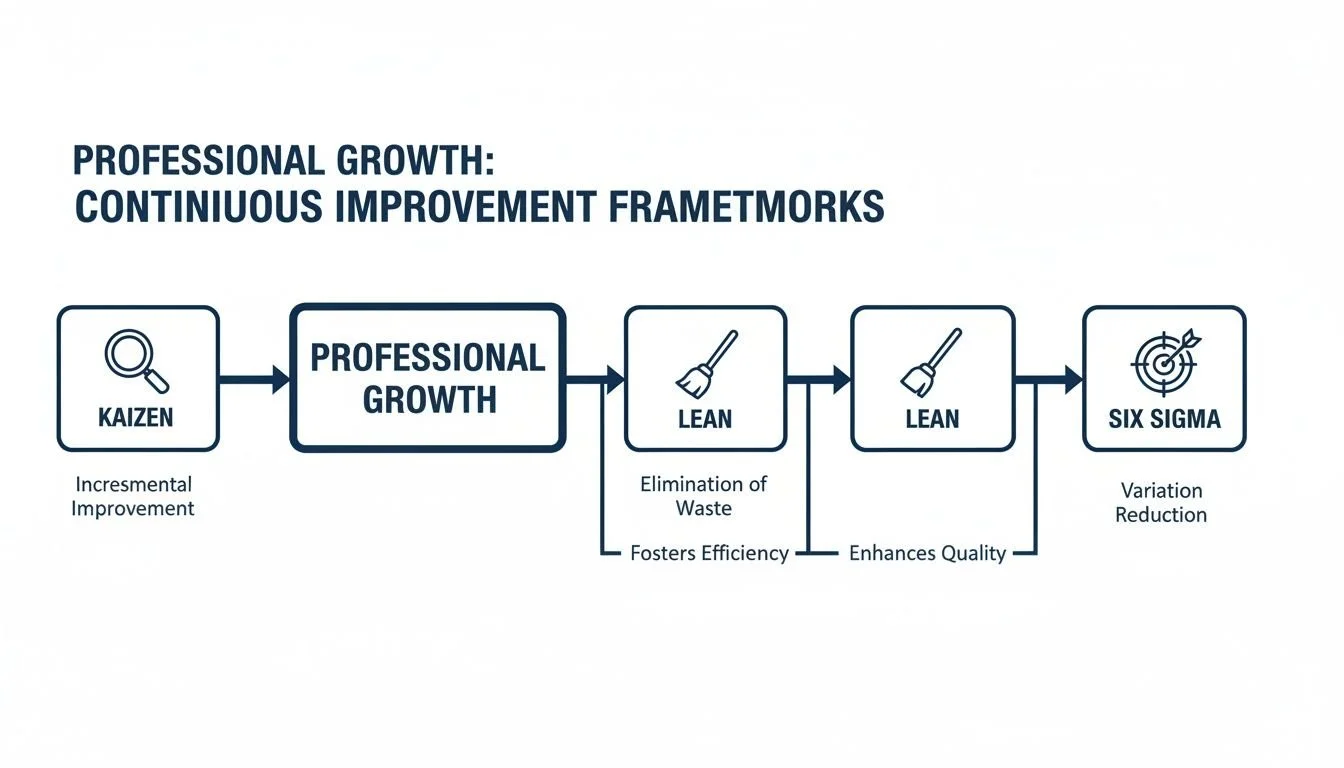
As you can see, Kaizen is all about the small details, Lean focuses on clearing away the junk, and Six Sigma zeroes in on quality. Each offers a distinct path to getting better.
For Junior Employees Using Kaizen
Picture a junior analyst named Sarah. Every single Monday, she burns three frustrating hours pulling data from three different systems to build a sales report. It's tedious, mind-numbing work, and she sometimes makes copy-paste errors that her manager has to fix.
The Problem: The reporting process is a mess—inefficient, error-prone, and a weekly source of dread.
The Kaizen Solution: Instead of just putting up with it, Sarah decides to apply a Kaizen mindset. She doesn’t try to automate the whole thing at once. In week one, she just learns a few spreadsheet formulas to format one section automatically. Boom, 15 minutes saved.
The Action: The next week, she creates a simple template to structure her data entry, which reduces the mental gymnastics and cuts down on mistakes. Over the next month, she makes one small improvement each week—learning a new function, colour-coding inputs, adding a summary chart.
The Career Win: After two months, her report is not only error-free but takes her just 45 minutes to complete. Her manager definitely notices the improved quality and, more importantly, the extra time Sarah now has for higher-value analytical tasks. She’s now seen as proactive and resourceful, earning her a spot on a more challenging project.
For Managers Applying Lean Principles
Now let's look at David, a marketing manager. His team's weekly planning meetings are a total train wreck. They regularly run over the scheduled hour, conversations get derailed by irrelevant sidebars, and people often leave more confused than when they started.
The Problem: The meeting is a massive source of "waste"—wasted time, wasted energy, and a lack of clear direction. It’s actively hurting productivity instead of helping it.
The Lean Solution: David decides to use Lean thinking to eliminate this waste. He starts by mapping out the process and quickly realizes the root of the chaos: there’s no clear agenda, no time limits for topics, and way too many people are invited "just in case."
The Action: David makes three simple changes. First, every meeting must now have a clear agenda with assigned time slots, sent out 24 hours in advance. Second, he rolls out a "no agenda, no attenda" rule. Third, he uses a whiteboard "parking lot" to capture off-topic ideas so they can be addressed later without derailing the current conversation. For more on focusing on high-impact work, check out our guide on mastering the 80/20 rule.
The Career Win: Within three weeks, the meetings are finishing on time, every time. The team is more engaged because the discussions are focused and actually productive. David’s director recognizes him for building an efficient and respectful team culture, proving he can improve systems, not just manage people.
"A Lean environment doesn't just drive cost cutting... We make sure we have the proper staffing levels. We allow people to do meaningful work." This highlights a key point: true efficiency isn't about burning people out; it's about removing the obstacles so they can truly shine.
For Senior Leaders Driving With Six Sigma
Finally, let's talk about Maria, a VP of Sales. She’s noticed a disturbing trend: a huge chunk of promising sales leads are dropping off during the handoff from the junior sales team to the senior account executives. Deals are stalling and potential revenue is just evaporating.
The Problem: The sales pipeline has a critical "defect" in its process, leading to a measurable loss of nearly 15% of qualified leads. The exact cause is a mystery, but the financial hit is obvious.
The Six Sigma Solution: This is a perfect job for Six Sigma. Maria kicks off a project with a clear, measurable goal: get the lead drop-off rate to under 3%.
The Action: Her team starts by meticulously measuring the problem, confirming the drop-off rate and pinpointing exactly where in the process it’s happening. After analyzing the root causes, they find two culprits: inconsistent qualification criteria and a sluggish handoff. The fix? They create a standardized lead-scoring checklist and an automated notification system to ensure senior reps follow up within 24 hours.
The Career Win: After running the new process for a single quarter, the lead drop-off rate plummets to just 2.5%. This isn't just a process win; it translates directly to a significant revenue boost. Maria proves her ability to use data-driven continuous improvement methodologies to solve a complex, systemic problem, cementing her reputation as a strategic leader who delivers bottom-line results.
Find Your Starting Point With This Quick Diagnostic

Knowing you want to improve is easy. Figuring out where to actually start? That's another story entirely. It's the paralysis of having too many options. But here's the thing: real change doesn't begin with a grand, sweeping vision. It starts with a sharp, honest look at your biggest friction point.
This diagnostic isn't some complicated exam. It’s just a handful of targeted questions to help you figure out where your energy is leaking and where a quick win is hiding. Answer them honestly, and you’ll find the clarity to pick the right tool for the job.
So, grab a pen or open a fresh note. Let’s turn that vague feeling of "I should be better" into a real plan.
Uncover Your Biggest Pain Points
Let’s get tactical. Think about your last work week. The aim here is to spot the recurring annoyances, the dumb mistakes, and the quality hiccups that are holding you and your work back. Answering these questions will shine a spotlight on where to focus first.
Which single, recurring task makes you want to pull your hair out or just sucks up way too much of your time?
Where do mistakes or rework constantly cost you time, credibility, or just your peace of mind?
What one skill, if you got just 1% better at it each week, would completely change your career trajectory?
Think about the last project that spiralled into chaos. What was the real source of that chaos?
Take a minute and actually write down your answers. Be brutally specific. "Meetings are bad" is useless. "The Tuesday morning project sync always runs 30 minutes over and has no clear agenda" is gold. That level of detail is everything.
Match the Problem to the Methodology
Okay, now let's look at what you wrote. Your pain points are a compass, pointing directly to the methodology that will serve you best. It's all about matching the right tool to the right job.
If you identified a frustrating, time-wasting task…
Your answer to that first question is a massive signpost pointing straight to Lean. If your week is choked with pointless reports, redundant data entry, or processes that make no sense, your biggest opportunity is to eliminate that waste.
Lean thinking is your professional decluttering tool. It's about systematically identifying and removing any activity that eats up resources but adds zero real value to your work or your team's mission.
Your first move? Map out that infuriating process from start to finish and ask, "Which of these steps are actually essential?"
If you identified a critical skill gap…
Your answer to the third question—the one about a game-changing skill—is a clear call for Kaizen. If you know that becoming a better public speaker, a faster coder, or a more persuasive writer would unlock new opportunities, then your focus needs to be on small, consistent, daily improvement.
Your first move? Break that big skill down into a tiny piece and commit to just 15 minutes of focused practice, every single day.
If you identified consistent mistakes or quality issues…
Did your answer to the second question hit a nerve? If you're constantly fixing errors in a monthly report, fielding complaints about quality, or watching projects fail for the exact same reasons, you're screaming for a Six Sigma mindset.
Your first move? Stop just fixing the mistakes and start tracking them. Look for the pattern. This is how you shift from being a firefighter to being a fire marshal—you move from reacting to problems to preventing them from ever starting.
By using this quick diagnostic, you can stop feeling overwhelmed and start feeling empowered. You’ll have a clear, actionable starting point to apply one of the core continuous improvement methodologies and kickstart your growth journey.
How Coaching Supercharges Your Improvement Efforts
Self-improvement is powerful, but let’s be honest: going it alone has its limits. While you can absolutely apply continuous improvement methodologies on your own, bringing in a coach is like adding a turbocharger to an already solid engine. They become your strategic partner, personalizing proven frameworks to accelerate your growth in ways you just can't do by yourself.
A coach isn't just a cheerleader; they're an expert at spotting what you can't. We all have professional blind spots—those inefficient habits, communication quirks, or outdated assumptions that keep us stuck. A great coach helps you see and eliminate this "waste," a core idea from Lean thinking, by asking the tough questions you’d never ask yourself.
They act as an objective set of eyes, pointing out the friction points you’ve gotten so used to that you don't even notice them anymore.
Turning Theory Into Targeted Action
It’s one thing to read about Kaizen’s “1% better” rule, but it’s a whole other challenge to figure out which 1% to focus on for the biggest impact. This is where a coach closes the gap between knowing and doing. They help you break down your huge career ambitions into small, manageable, incremental steps that actually build momentum.
Instead of a vague goal like "get better at presentations," a coach will push you to get specific. For instance, they might challenge you to focus solely on perfecting your opening statement this week, and then shift to improving your body language the next. This brings the disciplined structure of Kaizen directly into your personal development, ensuring your efforts are focused and not just scattered.
"When we give people answers, we're stealing a development opportunity from them." A coach's role isn't to hand you solutions, but to guide you in discovering them yourself. This process builds your problem-solving muscles for the long haul.
When you uncover the answer yourself, the improvement sticks. It becomes yours.
Driving Accountability and Measuring What Matters
The data-driven discipline of Six Sigma is fantastic for delivering high-quality work, but applying that same rigour to your own habits is tough without some accountability. A coach acts as your personal quality control system, helping you define what success looks like and then holding your feet to the fire to track real-world results.
Here’s how that process usually unfolds:
Defining Metrics: A coach helps you establish simple, clear metrics to track your progress. This could be anything from cutting down the time you spend on a repetitive task to getting more positive feedback from colleagues on your reports.
Creating Feedback Loops: They provide a consistent, honest feedback loop—celebrating your wins and challenging you when you fall short. This keeps you engaged when the initial motivation fades.
Analyzing Outcomes: Together, you dig into the results of your efforts. You learn from what worked and, just as importantly, from what didn't, so you can refine your approach for the next cycle.
This partnership turns vague intentions into a structured program for career growth. By personalizing these powerful frameworks, a coach helps ensure the changes you make aren't just temporary fixes, but a permanent upgrade to your professional operating system. You’re not just learning a new trick; you’re building the skills for long-term career resilience.
To see how this applies in different situations, explore the benefits of coaching at work for every career stage.
Your First Steps and Essential Resources
Feeling inspired is one thing, but turning that momentum into actual change is where the real work begins. This is the part where you stop reading and start doing. Don't let all the different continuous improvement methodologies paralyze you; the secret is to start small and build from there.
To turn what you've learned into immediate progress, here's a simple, no-excuses launch sequence.
Your Three-Step Launch Plan
This plan is designed to be dead simple and actionable. The goal is to make tangible progress this week.
Identify One Friction Point: Go back to your answers from the diagnostic. Pinpoint the single biggest annoyance or time-waster from your week. Be specific. Don’t just say "meetings"—say "that unproductive Tuesday sync where nothing gets decided."
Choose One Methodology: Based on that friction point, pick the single methodology that feels like the right tool for the job. Is it a tedious, repetitive task perfect for Lean? A skill gap you could close with a Kaizen mindset? Don't overthink it. Just pick one.
Commit to One Small Action: This is the most important step. Commit to one tiny, concrete action you will take this week. For example, if you chose Lean to fix that meeting, your action could be to draft and send a clear agenda 24 hours beforehand. That's it.
Committing to a single, small action is the antidote to analysis paralysis. The goal isn't to solve the entire problem at once. It's to prove to yourself that improvement is possible and to build the momentum you need for the next step.
These first steps are about building systems for your career, not just setting resolutions that fizzle out by February. To really dig into this mindset, you might want to check out our guide on building career systems instead of making resolutions. It's the perfect companion piece for turning these ideas into habits that stick.
Remember, the journey starts with a single step. Make it a small one.
Got Questions? Let's Clear Things Up
As you start thinking about how to bring continuous improvement methodologies into your own work, it's totally normal for a few questions—and a few mental roadblocks—to pop up. Let's tackle the most common ones head-on so you can get past the hurdles and start building some real momentum.
Can I Use These Methods if I Am Not a Manager?
Absolutely. In fact, these methods are often most powerful when you're an individual contributor. Think about it: Kaizen is all about making small, daily improvements to your own work.
You don't need anyone's permission to reorganize your digital files or spend 15 minutes a day mastering a new function in your team's software. These frameworks give you the power to take ownership of your personal processes and output—a guaranteed way to show initiative and get on leadership's radar long before you have a team of your own. Your career is your personal "process" to improve.
How Do I Measure Progress When the Changes Are So Small?
Fantastic question. It’s a common worry with approaches like Kaizen where the wins feel tiny. The key is to stop looking for huge, dramatic outcomes and start tracking small, leading indicators. You might not get a promotion in a week, but you can absolutely measure progress.
Look for simple, tangible metrics you can actually see:
Time Saved: Did that little automation you built shave 10 minutes off your weekly report? That’s a win. Track it.
Reduced Rework: Did your new pre-submission checklist help you turn in a project with zero errors for the first time? That’s progress.
Positive Feedback: Did a colleague mention how much easier your new meeting agendas are to follow? That's a measurable improvement in collaboration.
The goal isn't just to improve metrics; it's to develop people. Measuring these small wins provides the positive reinforcement needed to build lasting habits and confidence in your own ability to create change.
What Is the Biggest Mistake People Make When They Start?
The single biggest mistake is trying to do way too much, way too soon. Fired up by the possibilities, people try to apply Lean to their entire workflow, use Kaizen on ten different skills, and launch a Six Sigma project all at once. It’s a recipe for burnout.
The smart approach? Start with one, single, highly annoying friction point in your day. Apply just one methodology to it. Solve that one problem. Feel the win. Then, and only then, move on to the next one. The real power of continuous improvement methodologies comes from quiet consistency over time, not a frantic, short-lived burst of effort.
Ready to move past the FAQs and get some personalized guidance on your career? Corby Fine Coaching helps professionals identify their unique value and build systems for long-term growth. Start with a free chat to see how coaching can accelerate your journey.